
Choosing between pull-out shelves vs freestanding organizers starts with how you use the cabinet, not with which product looks more convenient in a picture. A removable organizer can be a simple way to group items, while a pull-out shelf can bring stored items forward instead of making you reach into the cabinet. The right choice depends on the cabinet opening, what you store, how often you use it and how much change you want to make.
Book a free consultation today.
By Paul Porreca, President and Owner
This comparison is for homeowners considering their existing cabinets. It is not a recommendation to replace cabinetry or remodel a kitchen. If the cabinet is a good candidate, the next step is to compare the organizer with the space and your daily routine.
What is the difference between the two options?
A freestanding cabinet organizer is a separate item placed inside a cabinet. It may be a bin, rack, tiered shelf, basket or small drawer unit. Many can be lifted out or moved without changing the cabinet. That makes them useful for grouping similar items, creating a second level for small goods or adjusting a storage arrangement as your needs change.
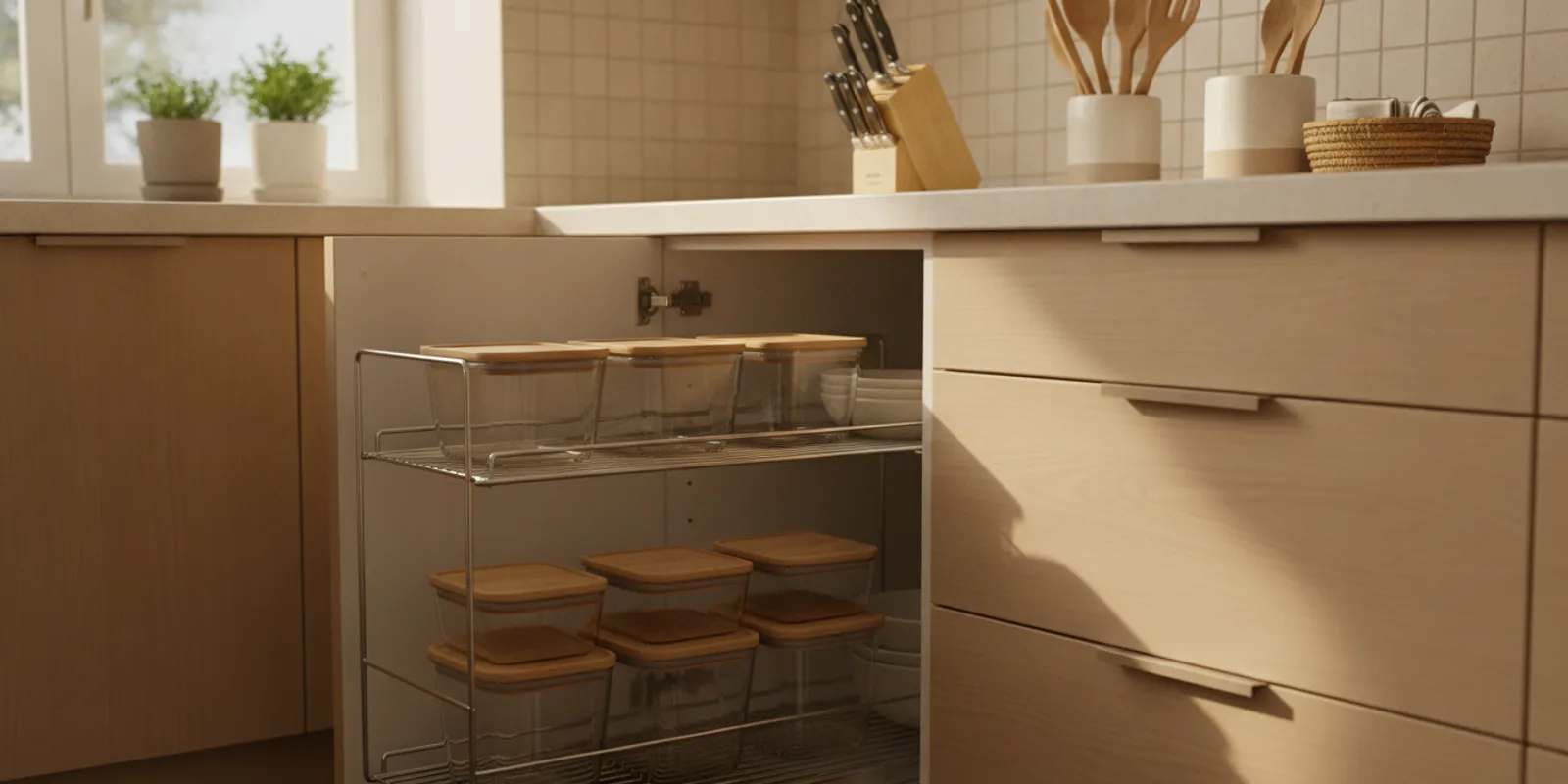
A pull-out shelf is fitted inside the cabinet and moves outward on slides. Rather than removing the organizer to get to something behind it, you pull the shelf toward the opening. Pull-out systems vary in design. Some are simple shelves, while others use drawers, baskets or adjustable components. A custom-fit option is planned around the cabinet’s measured interior and opening; the exact design depends on the cabinet and chosen hardware.
These options can address different problems. An organizer helps divide or stack items. A pull-out helps bring stored items closer to you. One does not automatically replace the other: removable bins can still be useful on a pull-out shelf, and some cabinets may be better served by a small freestanding organizer than by a fitted change.
How do they compare in everyday use?
| Factor | Freestanding organizer | Pull-out shelf |
|---|---|---|
| Access | Helps group or raise items; items behind it may still require reaching into the cabinet. | Moves the stored surface toward the opening, subject to the cabinet’s design and available clearance. |
| Stability | Rests on the cabinet floor or shelf; movement depends on its shape, surface and how it is loaded. | Attached slide hardware supports the moving shelf; fit, installation and the specific product matter. |
| Capacity | Limited by organizer size and the cabinet surface beneath it. | Depends on the shelf, slides, cabinet, installation and load distribution; check the product-specific rating. |
| Cabinet constraints | Must pass through the opening and fit around hinges, shelves and other obstructions. | Must be measured and planned around the opening, interior, hinges, center stile and other obstructions. |
| Ability to change layout | Usually easy to lift out or reposition. | Designed as a more lasting cabinet change; some systems have adjustable shelf positions. |
| Best starting point | Testing a new grouping, organizing light items or avoiding a fitted installation. | Frequently used items that are hard to see or reach at the back of a suitable cabinet. |
The table is a guide, not a guarantee that a particular cabinet or organizer will work. Size, construction and installation all matter. A removable organizer that is too tall to pass through the door opening will not be useful, and a pull-out that is not planned around the cabinet’s clearances can be a poor fit. Measure first, and avoid loading any product beyond its stated rating.
When is a freestanding organizer a practical choice?
Start with a removable organizer when you mainly need to separate items or make a small, reversible change. For example, a tiered rack can separate spice jars or small pantry containers; a bin can keep packets together; and a small shelf can create a second level for lighter items. In a bathroom cabinet, a removable container can group daily-use products without requiring you to change the cabinet.
Freestanding organizers can also be a sensible test. If you are not sure whether a new arrangement will suit your routine, try grouping the items first. Notice whether you can see what you need, whether the organizer slides or tips when you use it, and whether there is enough room to remove it for cleaning. That short trial can help you identify the real issue before choosing a more permanent solution.
- Choose removable storage for a temporary need. It is easy to rearrange when household routines or stored items change.
- Use it to group small items. A basket or bin can stop loose packages from spreading across a shelf.
- Consider the cabinet opening. Check both the organizer’s outside dimensions and the path through the doors.
- Check the base and load. A narrow or uneven organizer may shift, and the cabinet shelf beneath it still has its own limits.
- Keep useful clearance. Leave room for doors, hinges and neighboring items so the organizer can be used without constant rearranging.
A freestanding unit does not make deep storage easy to reach by itself. You may still need to move the front items to get to what is behind them. If that is the repeated frustration, adding another rack may create more layers without solving the access problem. In that case, consider whether bringing the storage forward would be a better match.
When can a pull-out shelf make more sense?
A pull-out shelf is worth considering when the main challenge is reaching into a deep cabinet or seeing items stored at the back. Pulling a shelf toward the opening can let you look across its contents and bring frequently used items within reach. The value is not simply adding another storage surface; it is changing how you get to the surface already inside the cabinet.
Think about lower kitchen cabinets where cookware, dishes, pantry supplies or small appliances are stored. A freestanding bin may organize smaller items, but it will not necessarily help you reach a pot behind another pot. Pull-outs may also be considered for bathroom cabinets where daily supplies sit deep inside. The actual solution must be selected cabinet by cabinet; a pull-out is not automatically suitable for every opening.
Frequency matters. If you reach for something every day, a modest improvement in access can be more useful than adding capacity for objects used once a year. If the cabinet holds rarely used serving pieces or seasonal supplies, a removable organizer may be enough. Start by identifying what you retrieve often and what remains difficult to see or reach.
Some systems include adjustable components. Shelf Proz describes its Shelf Pro system as a behind-the-cabinet-door pull-out with shelves that can move in two-inch steps on a hanger and grid. That description applies to the named system and should not be assumed of every pull-out shelf. Learn about height-adjustable pull-out shelves and compare the details with your storage needs.
Pull-outs can also be paired with other organization choices. A pull-out drawer may suit small items that benefit from a contained space, while an open pull-out shelf may suit larger objects that need a flat surface. Which form makes sense depends on what you store, the cabinet opening and the usable interior.
What cabinet details should you check before choosing?
Before buying an organizer or planning a fitted pull-out, look at the cabinet as a whole. A measurement of the shelf floor alone is not enough. The opening may be narrower than the interior, and a door, hinge, center stile, existing shelf or nearby plumbing may affect what can move in and out. Do not assume a product will fit or that the cabinet needs no changes until it has been checked.
- Measure the opening. Note the clear width and height with the doors in the position you normally use. Account for hinges and any center stile between doors.
- Measure the interior. Check the usable width, depth and height where the organizer or shelf would sit. Include obstructions and existing fixed shelves.
- Check the route in and out. A freestanding unit needs to pass through the opening. A fitted shelf needs a clear path as it moves outward.
- Look for nearby conflicts. Note plumbing, door swings, trim, handles and items in adjacent cabinets that could affect access or movement.
- List the items to store. Estimate their size and weight, and note which are used most often. Keep product load limits in mind.
- Take photos and measurements. A few clear views of the open cabinet can make it easier to discuss possible layouts. Measurements and photos do not replace a fit check.
For a project involving multiple cabinets, repeat the check for each one. Two cabinets that look alike from the outside can differ inside. A removable organizer can be tried in one cabinet first, while a fitted design should be discussed for the exact cabinet where it would go.
Homeowners comparing a larger set of existing-cabinet changes can review kitchen organization options and pantry organization ideas. For a bathroom project, see bathroom storage solutions. These pages describe areas of organization to consider, not a promise that every cabinet or address will suit a particular product.
How should you think about stability and capacity?
Stability is about more than whether a product feels solid when empty. A removable organizer sits on the cabinet surface, and its base, footprint, weight and contents affect how it behaves when you take items out. A pull-out uses slides and mounting points, so the chosen hardware, cabinet construction, installation and loading all matter. For either option, use it as directed and do not exceed the rating for that specific product.
Do not compare a general description such as “heavy duty” with a specific load rating unless the rating is documented for the exact product and configuration. Ratings on one component or model may not apply to a different shelf, cabinet, installation or arrangement. Shelf Proz’s site gives separate claims for particular Shelf Pro components; those figures should not be treated as ratings for every product or room. Ask for product-specific details when capacity is important.
Think about the weight distribution too. A stack of dishes or a heavy appliance concentrated at one edge may place different demands on a shelf than lighter, evenly arranged items. Store heavier items where they can be used safely and comfortably, and ask whether the intended cabinet and selected system are appropriate. A consultation can help review the layout, but the final choice needs to match the product instructions and cabinet conditions.
For general consumer product safety information, the U.S. Consumer Product Safety Commission provides a government reference. For a cabinet project, follow the specific organizer or hardware instructions and get qualified help if installation requirements are unclear.
Which choice is likely to suit your long-term plans?
Consider how settled your storage needs are. A freestanding organizer can move with you from one shelf to another, which is useful if you often change what a cabinet holds. It can also be removed if you want to return the cabinet to an open shelf. The tradeoff is that it may not solve deep access, and a collection of separate bins can take up some of the cabinet’s usable space.
A fitted pull-out is a more lasting change to how a cabinet is used. It may suit a homeowner who expects to keep the cabinet arrangement and regularly struggles to reach the back. It is not the same as replacing the cabinet or undertaking a full kitchen remodel. Its fit and usefulness depend on measurement and installation, and the cabinet’s constraints need to be reviewed before work is planned.
There is no need to decide that every cabinet needs the same treatment. One homeowner may use a pull-out shelf for frequently used cookware and removable bins for pantry packets. Another may find that a small organizer is enough in a shallow cabinet, while a deeper cabinet needs a different access plan. Treat each cabinet as a separate decision rather than purchasing a set of organizers before checking the space.
If you are unsure, compare the effort and outcome you want. Are you trying to separate items, create a second level, or bring the contents forward? Is flexibility more important than a fitted change? Is the cabinet used often enough that easier access would matter day after day? Clear answers to those questions help narrow the options without assuming that one approach is always better.
What should you bring to a free consultation?
A useful conversation begins with the cabinets and the problem you want to solve. Write down which items are hard to reach, how often you use them and what you have already tried. Bring cabinet measurements and photos if available. If you have a freestanding organizer in mind, note its dimensions and show how you intend to use it.
For a custom-fit discussion, ask what measurements or cabinet details are needed, whether the opening and interior appear suitable, and what factors could affect the design. Ask what the estimate includes and whether installation is included in the specific proposal. Do not assume that every product, shipping or installation cost is bundled together; ask for the scope and pricing for your project.
Shelf Proz offers a consultation and estimate process for residential cabinet organization. The site describes custom solutions for kitchens, pantries, bathrooms and garages, including pull-out shelves and drawers. You can review cabinet organization services and use the contact page to start a conversation. Service availability depends on the project location; confirm that your city or ZIP can be served before making plans.
Book a free consultation today.
Frequently asked questions
Can I use a freestanding organizer on a pull-out shelf?
Sometimes, if the organizer fits the shelf and does not obstruct movement or exceed the product’s load limits. Check its dimensions, base and intended use, and make sure it will not catch on the cabinet or door as the shelf moves. A combination can organize small items while retaining pull-out access.
Are pull-out shelves right for every cabinet?
No. Cabinet openings, interior dimensions, hinges, center stiles, fixed shelves and other obstructions can affect whether a design will work. A measurement and fit review is needed before promising that a particular pull-out will fit.
Will a freestanding organizer make the back of a deep cabinet easy to reach?
Not necessarily. A bin or tiered rack may group items or raise them for visibility, but items behind it can still require reaching into the cabinet or moving other contents. If repeated reaching is the main difficulty, compare that solution with a pull-out option.
Is one option always less expensive?
Not in every situation. Removable organizers vary by size and design, while a fitted project depends on the cabinet, selected components and installation. Ask for the complete cost of the specific option you are considering rather than comparing an organizer’s shelf price with an incomplete project estimate.
Make the choice cabinet by cabinet
Choose a freestanding organizer when grouping, flexibility or a small trial is the priority. Consider a pull-out shelf when the recurring problem is seeing and reaching items stored farther inside a suitable cabinet. Check the measurements, contents and cabinet constraints first, then compare the options for the way you actually use the space. A free consultation can help you discuss a custom-fit possibility without assuming that every cabinet needs the same solution.