
Custom pull-out shelves or cabinet replacement? The right direction depends on whether the problem is access to items inside a usable cabinet or the cabinet itself. If you are planning kitchen or bathroom storage changes, start by naming what is not working before choosing a product or a larger project. Shelf Proz focuses on cabinet organization for existing cabinetry, including custom-fit pull-out shelves and drawers; it does not offer a verified full kitchen remodeling service.
Book a free consultation today
Start with the problem, not the proposed solution
A useful first step is to describe the frustration in ordinary terms. Do you have to move several things to reach an item at the back? Are supplies stacked so high that you cannot see what is there? Do you need a different way to group cookware, food, toiletries, or cleaning items? Or is the cabinet damaged, poorly placed, or part of a room layout you want to change?
Those problems point in different directions. Pull-out shelves and drawers can change how you reach and organize items within an existing cabinet. They do not, by themselves, replace cabinet boxes, repair structural damage, change the room layout, or complete a renovation. A clear problem statement helps you tell whether a cabinet-organization consultation is relevant or whether you should first speak with a remodeling professional.
Try writing one sentence for each cabinet you are considering: “I want to reach the jars at the back without unloading the front,” or “The cabinet is damaged and I am considering a new layout.” The first describes an access issue; the second describes a cabinet or project-scope issue. This simple distinction can keep a storage conversation focused and make it easier to ask for the right kind of assessment.
When might pull-outs be worth discussing?
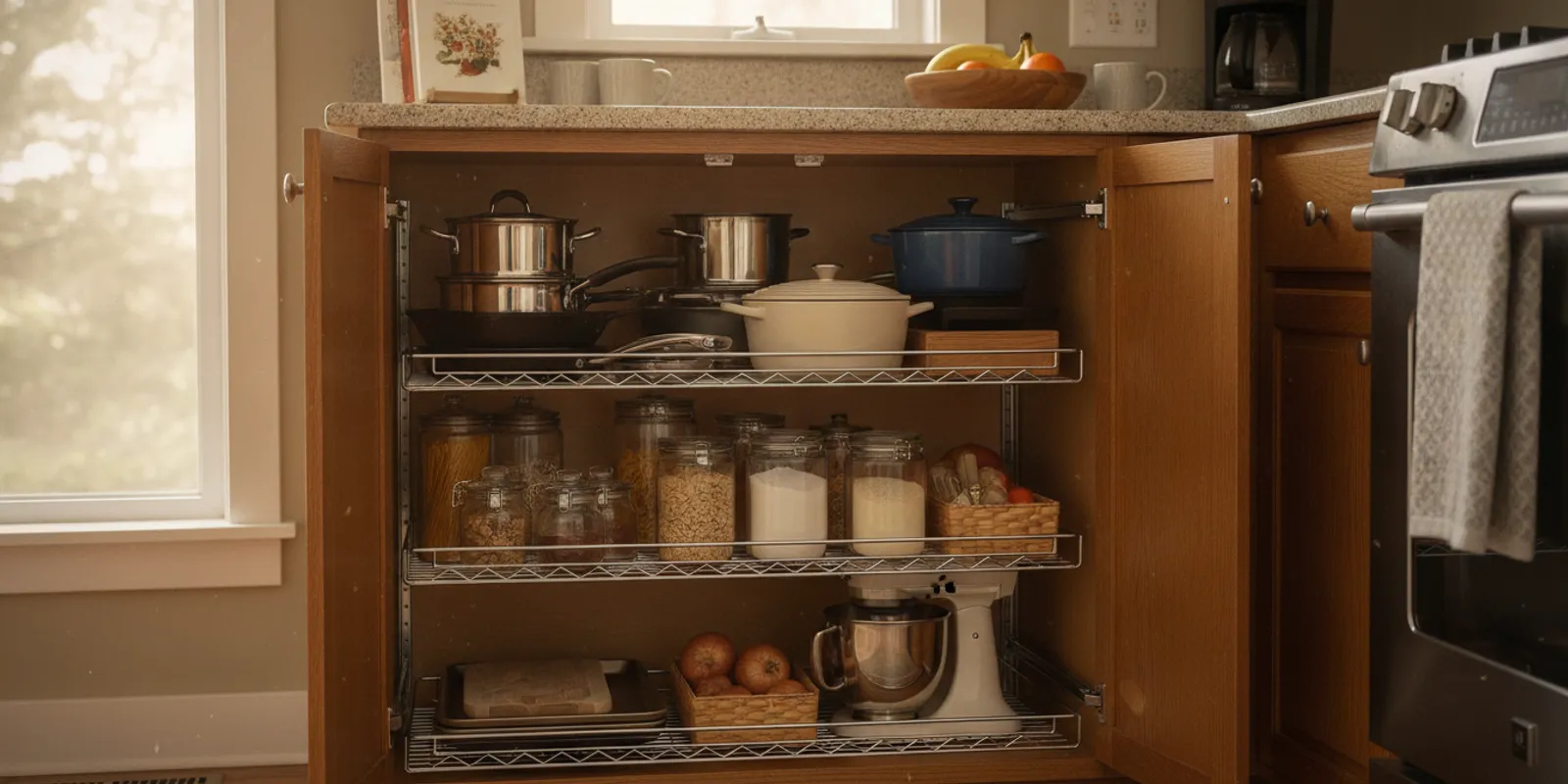
Custom-fit pull-outs may be worth exploring when the cabinet is in a useful location and your main concern is seeing, reaching, or grouping its contents. A shelf that slides forward can bring items from the back into view. A drawer may help separate smaller items. In a kitchen, you might want to group dishes, cookware, utensils, or small appliances. In a pantry, you might want food supplies easier to see. In a bathroom, the aim may be to organize daily essentials inside a cabinet.
Consider a base cabinet holding mixing bowls and pans. If the cabinet is sound and its location works, the issue may be that a fixed shelf makes the back difficult to reach. A pull-out could be a relevant direction to discuss. It would not solve a lack of counter space or change where the cabinet sits. Likewise, a bathroom cabinet may benefit from an organization change if the cabinet is usable but items are hard to retrieve; a leak or damaged cabinet needs a separate assessment.
Shelf Proz describes its Shelf Pro system as a behind-the-door pull-out with shelves that move in two-inch steps on a hanger and grid. The website also describes pull-out drawers and other shelf options. The right configuration depends on the cabinet and what you plan to store. Do not assume every opening will fit, that no changes will be needed, or that the same configuration suits every room.
For examples of the company’s stated scope, review its pages for pull-out shelf options, pull-out drawers, and kitchen organization. These options address storage within existing cabinetry. They should not be read as a promise that a particular cabinet will accept a specific product without a fit review.
When is cabinet replacement the better question?
If your concern involves the cabinet structure or a broader room plan, ask a qualified remodeling professional whether replacement is appropriate. You might be considering replacement because of significant damage, because the cabinets do not suit the room’s layout, or because your project includes work beyond cabinet storage. Those needs fall outside the verified scope of Shelf Proz’s cabinet-organization offer.
Replacement and pull-outs are not interchangeable choices. New cabinetry changes the cabinet itself; an organization upgrade focuses on how an existing cabinet is used. If you want to move cabinets, change the kitchen footprint, or coordinate cabinet work with counters, flooring, plumbing, or lighting, consult a provider who offers and can confirm that specific work. Do not assume a cabinet organization company performs those services.
Also separate cosmetic concerns from functional ones. A cabinet may look dated but still work well, while a cabinet that looks acceptable may have an access problem. Decide which matters most to you: appearance, storage access, condition, layout, or a combination. That does not determine the answer on its own, but it helps you explain what a successful project would change.
How do the two directions compare?
| Planning question | Custom pull-out shelves or drawers | Cabinet replacement |
|---|---|---|
| Main focus | Improve access and organization inside existing cabinets | Change or replace the cabinetry itself |
| Useful starting point | List items that are hard to see, reach, or group | Describe cabinet condition, layout concerns, and broader goals |
| What needs checking | Dimensions, opening, doors, hinges, center stile, plumbing, and other obstructions | Project scope, cabinet condition, design decisions, and related renovation work |
| Good question to ask | Can an organization option address this access issue in this cabinet? | What replacement scope and related work does the project require? |
| What not to assume | That every cabinet fits or needs no modification | That an access problem automatically requires replacement |
| Who to consult | A cabinet-organization provider for a fit and storage discussion | A qualified remodeling provider for replacement and broader renovation planning |
This table is a planning aid, not a fit assessment or a quote. The word “custom” does not remove the need to measure and check the cabinet. A consultation can help clarify whether the storage issue fits the company’s scope and what information is still needed.
How can you assess the cabinet before choosing?
Look at the cabinet as it is now, and note what you know without trying to make a final design. Approximate width, depth, and height can help frame a discussion. Also note whether the cabinet has a center stile, unusual hinges, plumbing, a fixed shelf, or another obstruction that could affect movement. Take clear photos with the doors open and closed. Measurements and photos are useful starting points, but they do not guarantee that a proposed configuration will fit.
- Which items do you want to store, and how tall, wide, or heavy are they?
- Which items do you use every day, and which are occasional?
- Where does access become difficult: at the back, below a fixed shelf, or behind a door?
- Are hinges, a center stile, plumbing, or other features in the way?
- Is the cabinet in good working condition, or have you noticed damage or movement?
- Are you seeking storage changes only, or do you also want cabinet or room renovation?
Then think about the contents rather than just the empty opening. A cabinet for light pantry packets has different needs from one used for cookware or small appliances. Make a short list of typical items, including any unusually tall or bulky pieces. If you are unsure which shelf style might suit them, explain how you use the cabinet and ask what options are appropriate.
Product specifications also need context. The company describes different components and configurations, and its site gives separate claims for slides and fully extended shelves. Do not treat a published figure for one component or configuration as a rating for every shelf or cabinet. Share what you plan to store and ask which product details apply to the particular option under discussion.
Use a cabinet-by-cabinet decision process
If several cabinets are involved, assess them one at a time. A kitchen can have an access problem in one base cabinet, a separate pantry organization need, and a cabinet that is damaged or no longer suits the room. Those do not have to be treated as one all-or-nothing decision. Separating the needs may reveal that an organization upgrade is worth discussing for one cabinet while another needs a different kind of evaluation.
- Choose one problem cabinet. Start with the cabinet that creates the most frequent frustration. Avoid measuring the entire kitchen before you know what needs attention.
- Describe the current use. List the contents and how often you reach for them. Note what must be moved, lifted, or shifted to reach an item.
- Identify what should stay the same. For example, you may want to keep the cabinet location and basic layout while making items easier to access. If you do not want to keep the layout, say so.
- Record constraints. Note visible damage, unusual openings, hinges, a center stile, plumbing, and nearby doors or appliances that may affect clearance.
- Match the question to the project. Ask a storage provider about organization and fit. Ask a remodeling provider about replacement or broader room work.
- Compare written scope. If you receive proposals, make sure each one describes what work is included, what is excluded, and which assumptions still need confirmation.
For example, suppose a homeowner has a deep kitchen cabinet that holds pots and lids, and the cabinet is otherwise in good condition. They can list the cookware, photograph the open cabinet, and ask whether an appropriate pull-out configuration could improve access. If the same homeowner also wants to move the sink and change the cabinet layout, that is a separate remodeling scope. A storage consultation should not be treated as a substitute for that broader plan.
Or consider a bathroom cabinet where toiletries are crowded and difficult to see. If the cabinet itself is sound, the homeowner can describe the items and the access problem. If there is water damage, first explain that condition and ask which professional should evaluate it. Storage products should not be presented as a repair for damage.
What should you bring to a consultation?
A useful consultation starts with a clear goal and honest limits. Shelf Proz describes a process that may include discussing goals, measuring, designing a solution, and professional installation. The precise fit, project scope, and service availability need to be confirmed for your particular project. To make the conversation more productive, bring:
- Photos of each cabinet with doors open and closed.
- Approximate interior and opening measurements, if you have them.
- A list of items you want to store, including bulky or unusually tall items.
- A brief note describing the access problem and what you want to change.
- Details about visible damage or obstructions such as hinges, a center stile, or plumbing.
- Your city or ZIP code, so availability for your address can be confirmed rather than assumed.
Measurements are helpful, but ask whether the provider needs to verify them. Cabinet openings can include details that a quick width measurement does not capture. Photos can show some of those details, but they do not replace a project-specific fit review. Do not commit to a product based only on a general example or a picture of another cabinet.
Which questions should you ask before moving forward?
Ask direct questions that distinguish the storage offer from work outside its scope. The answers should apply to your cabinet, not just to a general product description.
- Does my concern fit cabinet organization, or does it call for cabinet replacement or other renovation work?
- What measurements or photos would help you review the cabinet?
- Could the door, hinges, center stile, plumbing, or cabinet construction affect the design or installation?
- Which pull-out configuration could suit the items I plan to store, and what specifications apply to it?
- What exactly is included in the estimate, and are the product, shipping, and installation costs separate?
- What warranty terms apply to the specific components being discussed?
- Can you confirm whether service is available for my city or ZIP code?
Ask for project-specific answers rather than assuming a price or service area. The company FAQ gives approximate prices for individual drawers: about $80 for a small drawer and $150 or more for a large drawer, varying with size, materials, quantity, and finish. Those figures are not a project price. Grids and slides are separately supplied in the Shelf Pro Kit, generally one kit for two drawers depending on layout; shipping is extra, and installation costs vary by cabinet and installer. Request a free estimate for the work under discussion.
Likewise, ask what the stated warranty covers. The site describes a lifetime materials warranty on drawers, slides, and grids, with terms available on request. Do not assume this means lifetime coverage for installation labor or every service. Get the relevant terms for the components and project you are considering.
How should you prepare without committing to a direction?
You do not need to decide between an organization upgrade and replacement before gathering basic information. Start with one or two cabinets, describe what is difficult about using them, and note what you want to store. If the cabinet appears damaged or your goals include changing the room, state that plainly. A provider can then help clarify whether the request fits its service or point out that a different kind of assessment is needed.
For kitchen storage examples, see the pages on pantry organization and height-adjustable pull-out shelves. For bathroom storage, review bathroom storage solutions. These pages can help you describe the kind of access or organization you want. They do not establish that a particular cabinet will fit a product, nor do they promise availability at every address.
For a limited general reference on cabinet configurations, the National Park Service describes stationary and pull-out shelves among storage cabinet options in a museum context: Conserve O Gram 4/1a: Museum Storage Cabinets. This is not a residential fit guide or a recommendation for a particular home product. Your cabinet still needs a project-specific review.
Keep the project scope clear
Cabinet organization is a focused way to improve storage and access within existing cabinetry. Cabinet replacement is a different project direction, especially when the concern involves cabinet condition or room changes. If your goal is easier access to kitchen, pantry, or bathroom items, bring measurements, photos, and a list of what you store to a consultation. If you are planning replacement or full remodeling, consult a provider who confirms that scope.
Book a free consultation today
A clear description of the cabinet, its condition, and the problem it presents is the best place to begin a practical conversation.