
Choosing between pantry pull-out drawers vs. fixed shelves depends on what you store, how often you reach for it, and how your cabinets are built. Drawers bring stored items forward; fixed shelves keep the cabinet simple and can work well when you can see and reach what is inside. Many kitchens benefit from a mix rather than one solution everywhere.
Book a free consultation today
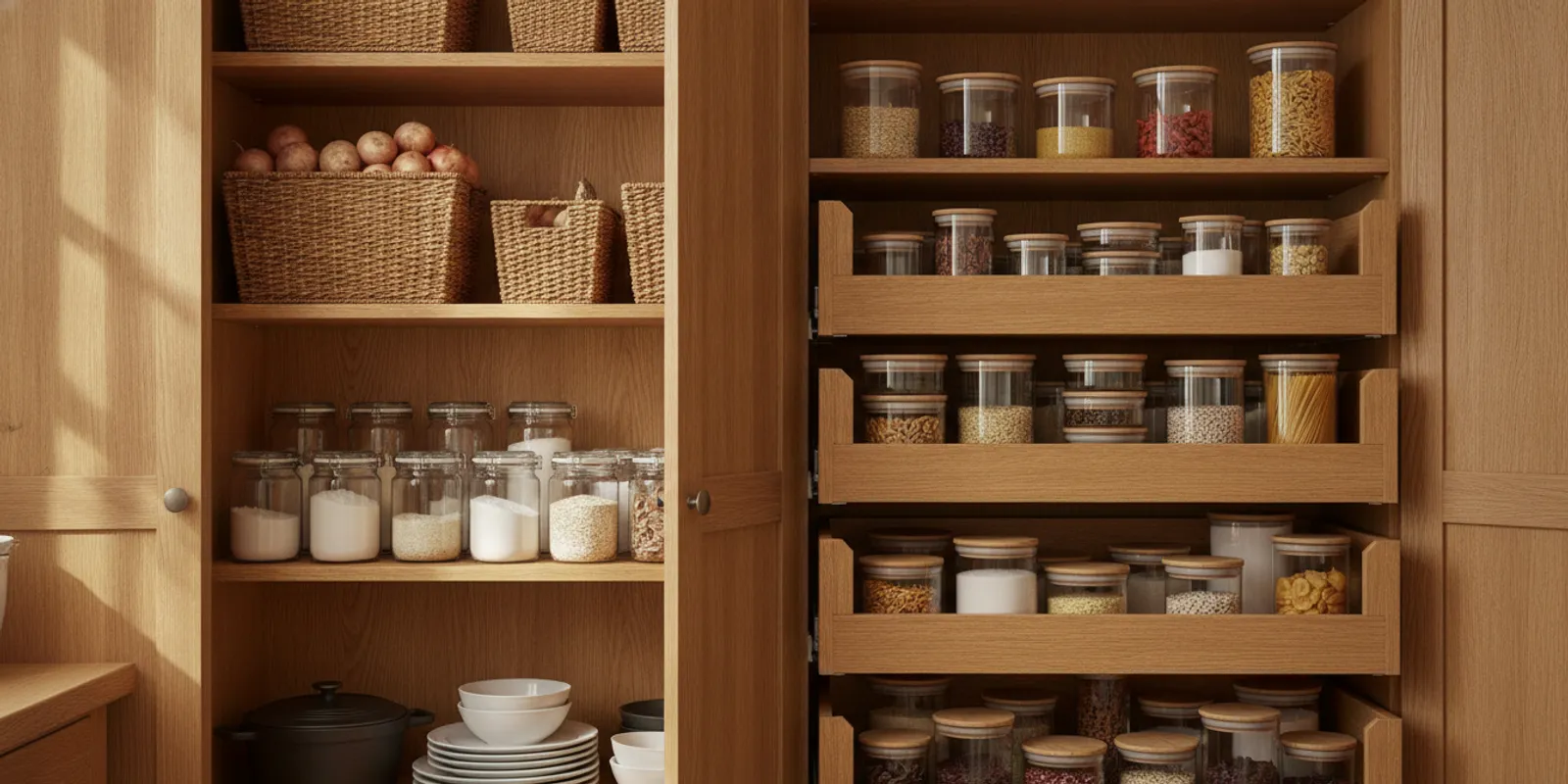
What is the difference between pantry pull-out drawers and fixed shelves?
A fixed shelf stays in place. You reach into the cabinet and retrieve items from its surface. A pull-out drawer or shelf travels outward on slides, bringing part of the stored area closer to you. Shelf Proz describes custom-fit pull-out shelves and drawers for existing cabinets; the appropriate design depends on the cabinet, its contents, and the access problem you want to solve.
The options change access, not the cabinet’s total volume. A pull-out can make some storage easier to inspect, but it does not guarantee that more items will fit. A fixed shelf may be practical for light, visible items you use often. Neither choice is automatically best for every cabinet or homeowner.
It also helps to distinguish a drawer from a pull-out shelf. A drawer has sides that can help contain smaller packages. A shelf offers a flatter surface for larger containers or packages. The actual useful space depends on the design and cabinet opening, so think about the items you plan to store rather than choosing based on the name alone.
How do the two options compare in everyday use?
| Consideration | Fixed shelves | Pull-out drawers or shelves |
|---|---|---|
| Reaching items | You reach into the cabinet; items at the back may be harder to see or retrieve. | The moving surface can bring stored items forward, subject to fit and design. |
| Visibility | Works best when depth and arrangement let you see the contents. | Extending the shelf can make contents easier to view. |
| Containment | Depends on containers and how items are grouped. | Drawer sides may help contain smaller items; a shelf provides a flatter surface. |
| Layout flexibility | Stationary arrangement; repositioning depends on the existing cabinet. | Custom options may be available; the Shelf Pro system is described as adjustable in two-inch steps. |
| Cabinet constraints | Depth, width, height, and fixed features affect use. | Opening width, hinges, center stiles, plumbing, and clearance may affect design or installation. |
| Planning | Review grouping and spacing. | Review measurements, contents, clearances, and installation scope. |
Use this comparison as a starting point, not a product guarantee. A configuration that works in one cabinet may not fit another that looks similar from the outside. Measure and discuss the actual space before deciding what to install.
When might fixed shelves be the better fit?
Fixed shelves can make sense when you can comfortably see and reach the items you store. A shallow cabinet with a few frequently used containers may not need a moving component. Fixed shelves may also suit items that are rarely accessed, provided the arrangement does not make retrieval difficult.
Try a simple reset before changing the cabinet. Group similar foods, move everyday items to the easiest-to-reach area, and place taller or less-used items where they do not block smaller packages. Then use the cabinet as you normally would for several days. If you can find what you need without shifting several things, the current shelves may be adequate.
Fixed shelves can also be sensible when contents are already organized and the cabinet has no recurring access problem. They do not require you to pull a loaded surface outward. But that does not mean every fixed shelf is easier for every household. Cabinet height, depth, and daily routine all matter.
Consider a shallow upper cabinet holding tea, cereal, and a few breakfast bowls. If labels are visible from the front and the items are light enough to move easily, grouping by use may solve the problem without hardware. A fixed shelf is also useful when the items need to remain on a broad, uninterrupted surface or when you prefer to keep the cabinet arrangement unchanged. The test is practical: can you put away and retrieve the items without repeatedly rearranging the front row?
When can a pull-out help in a pantry?
A pull-out may be worth discussing when packages disappear at the back, when you routinely remove several items to reach one, or when lower shelves are awkward to inspect. Extending the storage surface can make it easier to see and reach contents. It is an access change, not a promise that every item will fit or every cabinet can accept the same hardware.
Imagine a deep base cabinet where cans or jars collect behind larger containers. If you repeatedly move front items to check what is behind them, a pull-out could make the area easier to inspect. If the same cabinet holds a few tall appliances that are rarely used, a fixed shelf may be workable. First identify the repeated task that feels awkward; then consider whether moving the shelf addresses it.
In a tall pantry cabinet, the main issue may be shelf spacing rather than depth. Tall packages can waste vertical room when shelves are spaced for shorter items, while small packets can become difficult to locate on a deep, crowded surface. Think about whether the problem is reach, visibility, grouping, or vertical clearance. Different zones can call for different approaches.
Before selecting a pull-out, try a small real-world test. Take out the contents and place them on a counter in the order you use them. Notice which items need to stay together, which packages are too tall for a planned level, and whether any container is unusually wide or heavy. Then return the items temporarily and observe where your hand naturally reaches. This inventory turns a vague complaint into a design question: does the moving surface need sides, a flat platform, or a different height arrangement?
Shelf Proz’s pages about pantry organization and kitchen organization provide context for these storage needs. You can also review descriptions of pull-out drawers and pull-out shelves before asking about a specific cabinet.
What should you check before choosing?
Review each cabinet separately. Note the items that cause frustration, then look at the cabinet itself. A pull-out needs usable space and clearance to travel. Hinges, a center stile, cabinet width, and other fixed features may affect design or installation. Photos and measurements can help start a conversation, but they do not guarantee fit.
- Name the access problem. Is the issue reaching the back, seeing labels, stacking packages, keeping small items together, or adjusting shelf spacing?
- List intended contents. Include approximate dimensions and whether items are light, bulky, fragile, or used every day. This helps distinguish a drawer question from a shelf question.
- Observe the opening. Note width, height, depth, door swing, and any divider or obstruction you can see. Do not assume the visible opening equals the full usable interior.
- Take useful photos. If practical, photograph the cabinet empty, with the door open and a clear view of hinges and interior. Include a wider view showing surrounding cabinets. Photos can support an initial discussion but do not replace measurements.
- Compare the proposed scope with the need. Ask what moves, what remains fixed, what components are included, and whether installation is part of the estimate.
Make a short cabinet inventory. For each cabinet, write down the contents, the most-used items, and the specific moment that causes frustration. “I move cereal boxes to reach the cans” is more actionable than “the pantry is messy.” A clear example helps you discuss whether reorganization, a fixed-shelf adjustment, a drawer, or a pull-out shelf is worth considering.
Measure in a consistent way, but avoid treating a tape-measure reading as a fit decision. Record the inside width, depth, and usable height, then note where hinges, a center stile, plumbing, or other features intrude. A door opening can be narrower than the interior. That difference matters because the moving component must pass through the opening, not simply fit inside the cabinet once installed.
For example, a cabinet may appear wide enough for two groups of jars when the doors are open, yet a center stile or hinge may limit the route a pull-out can travel. A low shelf may also have less clearance than its height suggests if the door or neighboring cabinet affects movement. These are reasons to request an assessment, not reasons to assume a particular design will or will not work.
For another product option, Shelf Proz describes a height-adjustable pull-out system. Ask how a proposed configuration would fit your cabinet rather than assuming a product description applies to every room or installation. The site describes Shelf Pro shelves as adjustable in two-inch steps; this may be useful to ask about when stored items vary in height. It does not mean every cabinet supports every arrangement.
How should you compare cost and installation?
Compare the complete scope, not only the visible drawer or shelf. Shelf Proz’s site gives approximate examples for individual drawers: about $80 for a small drawer and $150 or more for a large drawer. Those examples vary by size, materials, quantity, and finish. They are not a project price. Slides and grids are separately supplied in the Shelf Pro Kit, generally one kit for two drawers depending on layout; shipping is extra, and installation cost varies by cabinet and installer.
There is no sound way to turn a single-drawer example into a total pantry estimate. A project may involve different drawer sizes, a different number of units, hardware, shipping, cabinet conditions, and installation. Ask for an itemized estimate that says what is included, what is separate, and which cabinets it covers. If you compare proposals, compare the same cabinet list and the same scope.
Ask whether measurement or design is part of the proposed work and what installation covers. The site describes a free consultation and estimate, but the recommendation depends on cabinet details. Financing is mentioned on the site, but no rate or terms should be assumed. Request current details directly. The lifetime warranty statement concerns materials on drawers, slides, and grids; ask for terms and do not assume it covers labor or every service.
Before agreeing to a change, make sure the written scope matches the conversation. It should be clear which cabinet is being addressed, whether the plan uses a drawer or shelf, what hardware is included, and whether installation is included or separate. Ask who handles any cabinet-specific issue that may arise during installation. A clear scope makes it easier to compare options without relying on assumptions.
A simple comparison worksheet can keep proposals organized. Use one row per cabinet and record the recommended solution, number and type of moving components, separate hardware, shipping, installation, and any stated warranty terms. Leave unknown items marked as questions rather than estimating them yourself. If one proposal includes installation and another lists it separately, the headline figures are not comparable until you account for the different scope.
How can you make a cabinet-by-cabinet decision?
Use a simple priority scale. For each cabinet, rate access frustration as low, medium, or high. Then mark whether contents are visible, whether items block one another, and whether you need to bend or reach deep. This is not a technical measurement; it helps focus attention on cabinets where a change could matter most.
- Low frustration: Items are visible and reachable. Keep the current arrangement unless another need justifies a change.
- Medium frustration: Some items are hard to reach. Try reorganizing by frequency and size, then see whether the problem remains.
- High frustration: Items are repeatedly hidden or blocked. Gather photos and measurements and ask whether a pull-out configuration is feasible.
Consider a hypothetical pantry with three zones. The upper shelf holds seldom-used serving pieces, the middle shelves hold breakfast staples, and a deep lower cabinet holds cans and heavy jars. The upper shelf may need better grouping, the middle section may work with fixed shelves if items are visible, and the lower cabinet may deserve a pull-out discussion if items keep getting trapped behind one another. This mixed plan avoids treating every cabinet as if it had the same job.
You can mix solutions across a kitchen. One cabinet may work well with fixed shelves while another may benefit from a pull-out. Also consider how pantry storage connects with adjacent kitchen cabinets: cookware, dishes, and food have different access patterns. Shelf Proz focuses on existing residential cabinets rather than a verified full kitchen remodel, so keep the discussion centered on the storage change you need.
Run the plan through a normal week before settling on it. Which items do you reach for each morning? Which packages come home in bulk and need a stable place? Are there ingredients you use together that should share a zone? For a household that cooks often, frequently used oils, spices, and pantry basics may deserve easier access than holiday dishes. For a household that stores bulk packages, the useful question may be whether the package can fit without blocking smaller daily items. The right arrangement follows real habits, not a generic diagram.
What should you ask at a consultation?
Bring a short list of cabinets and explain what you want to reach more easily. Ask whether the proposed item is a drawer or shelf, how it moves, what measurements are needed, and what cabinet features could affect fit. These questions connect the proposed product to your routine rather than treating a product category as a complete answer.
- Which cabinet problem does this option address, and what would remain unchanged?
- What measurements or photos do you need to assess fit?
- Could hinges, a center stile, plumbing, or the door opening affect the design?
- Which hardware and components are included, and what is separate?
- Does the estimate include installation? If not, how is that scope handled?
- What warranty terms apply to these materials, and what is outside that coverage?
Review Shelf Proz’s cabinet organization services and project photos for context, then ask about your own cabinet details. If you are in Las Vegas, Henderson, Lake Havasu City, Kingman, Bullhead, or Laughlin, confirm service availability for your exact address or ZIP. These are priority areas, not a guarantee every location is served.
When comparing advice, keep the question tied to the cabinet and your intended contents. A suggestion to add a pull-out should explain which access issue it addresses and how the moving part clears the opening. A suggestion to keep fixed shelves should explain why the current depth and spacing are workable. If the answer is unclear, ask for the reasoning in plain terms and check that the estimate describes the same solution you discussed.
Book a free consultation today
For general context on household food storage and safe handling, the U.S. Department of Agriculture provides its food safety guidance. For example, keeping pantry items grouped and labels visible can make routine checks easier; follow product labels and food-safety directions for the items you store.
Frequently asked questions
Do pull-out drawers create more pantry storage?
Not necessarily. They change how you reach stored items, but the usable space depends on cabinet dimensions, the moving unit, and clearance. Compare the actual interior and intended contents rather than assuming a pull-out increases capacity.
Are drawers and pull-out shelves the same?
No. A drawer has sides that can help contain smaller packages, while a shelf is a flatter platform. Which is more useful depends on item size, how you group things, and the cabinet design.
Can every existing cabinet take a pull-out?
Do not assume so. The opening, hinges, center stile, plumbing, and other features can affect fit and travel. Measurements and photos help start an assessment, but do not guarantee a particular configuration will work.
Should I replace all fixed shelves at once?
Not automatically. Identify which cabinets cause repeated access problems and consider them individually. A mixed arrangement can make sense when some areas are easy to reach and others are deep or crowded.
Make the choice cabinet by cabinet
Fixed shelves can be sensible when items remain visible and reachable. Pull-out drawers or shelves may help when deep storage makes everyday access frustrating, but cabinet fit and project scope need to be checked. Identify the problem cabinet, note what you store, and ask for a custom assessment before deciding which approach belongs in your pantry.