
By Paul Porreca, President and Owner
Pantry shelving works hardest when it makes everyday items easier to see and reach, but the best material depends on more than appearance. An existing cabinet may need room for drawer boxes, adjustable shelves, hinges, and a center stile.
Book a free consultation today
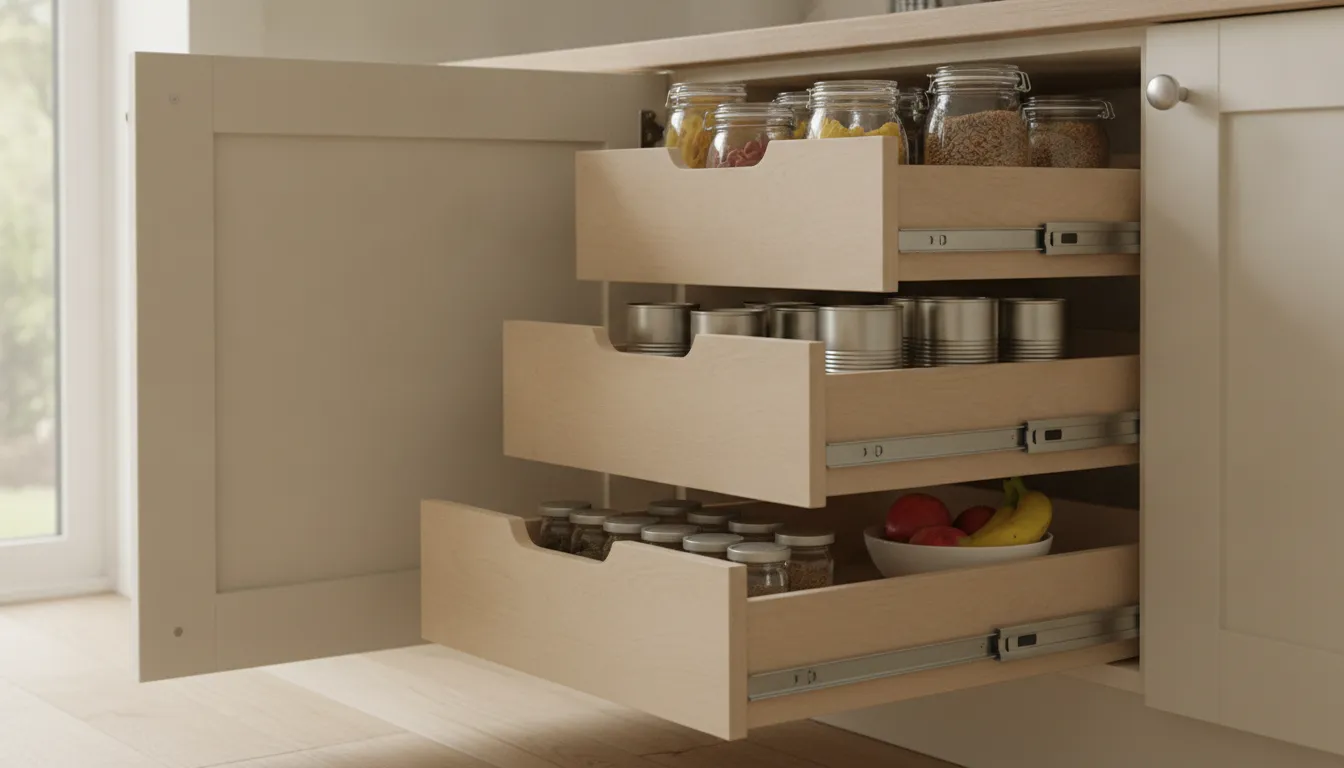
To decide how to choose pantry shelving materials, compare the cabinet’s available space with the job each part must do. Baltic birch plywood with dovetail joinery suits durable drawer boxes. Melamine grids handle adjustable shelf organization. Heavy-duty stainless-steel undermount slides provide smooth pull-out access. Finishes can then match the room and your priorities.
After comparing materials, you can also read our guide to pantry pull-out drawers vs. fixed shelves to compare everyday access and cabinet fit before choosing a pantry layout.
Material choices are easier once you separate the storage system into its working parts. A drawer box needs strength and stable joinery, while a grid needs useful adjustment and a finish that suits the kitchen. Before choosing either, look closely at the cabinet opening, interior dimensions, and any hardware or center stile that could affect the fit.
Start With the Cabinet, Not the Shelf Board
The right pantry shelving material depends on the cabinet you already have. Before comparing Baltic birch, melamine, or another finish, look at the available width and depth. An existing cabinet may have a narrow opening, limited interior depth, or a center stile between its doors. Those details change which shelf or drawer will fit.
Also consider what you plan to store. Food containers may call for easy access across several shelf levels. Cookware can need a different amount of clearance, while small appliances may require a deeper or wider pull-out. Household essentials can add another mix of shapes and sizes. A material is more useful when it matches how you use the pantry, not just how a sample looks. You can see how this fits broader pantry organization work.
The center stile deserves specific attention. If the cabinet dimensions allow it, a wider drawer may require removing the stile to create a broader opening. In other cases, keeping the stile may mean working around it with a partition or a cutout. Base that choice on the cabinet itself. Do not assume every cabinet can take the same drawer.
What to measure before choosing materials
- Measure the clear opening width inside the cabinet opening.
- Measure the usable interior depth from front to back.
- Measure the opening height and the height available at each level.
- Note the width and position of any center stile, hinges, or other obstructions.
- Note the approximate size of the food, cookware, or small appliances you want to store.
Photos can show details that a tape measure misses, especially around the doors, hinges, and stile. Share measurements or photos before you choose a material, so the options can be checked against the real cabinet. This check also separates a finish you like from a limit the cabinet has. A consultation can then look at keeping the stile, using a partition or cutout, or trying another layout.
Baltic Birch Drawer Boxes and Dovetail Joints
For a pantry drawer that opens several times a day, the box material and the joints are practical details. Shelf Proz publishes its standard drawers as premium Baltic birch plywood with dovetail joinery. The drawer walls are normally 1/2 inch thick, while the bottoms are typically 1/4 inch thick. Some larger drawers use 1/2-inch bottoms.
That construction gives you a clear point of comparison. Pantry drawers may hold canned goods, small appliances, cookware, or other household essentials. They also open and close often, so a well-built box belongs in the same conversation as the cabinet layout and the hardware. Baltic birch plywood is what Shelf Proz uses for its standard drawer boxes. It is not the only suitable material, and it is not claimed to be the strongest option.
Dovetail joinery is another part of the published design. Dovetail joints lock the sides together instead of relying only on a fastener at each corner. The result is a drawer box made for ordinary pantry use inside an existing cabinet. You can see the pull-out drawers and how they are set up for a particular space.
Thickness still depends on the drawer. A larger drawer may use a thicker bottom. The right design depends on the drawer size, the cabinet opening, the contents, and the clearance. A wider drawer can also affect the cabinet structure. In some installs, a center stile may need to come out if the cabinet allows it. Keeping the stile may call for a partition or a cutout. Measurements and photos show what is practical before any work begins.
Finishes can be customized, including white, black, wood finishes, and melamine finishes. Custom colors carry an extra charge, and individual drawer pricing varies by size, materials, quantity, and finish. Those details differ from one pantry to another. A free consultation is the way to get a number for your project. Pantry organization can be planned around what you store, how you use the space, and the cabinet an installer finds.
How to Choose Pantry Shelving Materials for the Grid
Pantry shelving materials need to look at home in the kitchen and hold up to regular use. Shelf Pro adjustable grids use a modern melamine design with a Hard Rock Maple finish. The surface gives the grid a warm wood look. The pantry does not have to be finished in one style. Other color and finish choices are available, including white, black, wood finishes, and melamine finishes. Custom colors may cost extra. Ask which options are available for your project.
The grid is also how the Shelf Pro system adjusts. Its hanger has slots every 2 inches, so the shelves can move in 2-inch steps as your storage changes. That spacing is how these shelves adjust. It is not a rule that every pantry shelf should sit 2 inches apart. The right arrangement still depends on what you store, how you want to reach it, and the cabinet measurements. You can see how the system works on these height-adjustable pull-out shelves.
Cleaning melamine in a pantry
Melamine is practical in a pantry because its smooth surface wipes clean during ordinary use. Dust, crumbs, and small spills are easier to handle when you catch them, instead of leaving them between stored items. Use a soft cloth or sponge with a mild household cleaner. Then wipe away leftover cleaner and moisture. Follow the cleaner label. Skip abrasive tools or harsh products that could damage the finish.
A pantry can get occasional humidity or spills, especially near food and kitchen work. Wipe up moisture instead of letting it sit on the grid or pool around the edges. Melamine cleans readily. It is not waterproof, and it is not mold-proof. Keep containers closed, fix leaks, and let damp surfaces dry. That is still part of pantry care.
When you choose pantry shelving materials, look at the surface you will clean and the flexibility you want later. A consultation can match the grid finish and the shelf layout to your cabinets, your items, and your measurements.
How Drawer Boxes, Grids, and Slides Differ
A pantry pull-out works as a system. The shelf you see is only one part of the choice. The drawer box is the container. The grid supports adjustable shelving. The slides let the assembly move toward you. Those roles make it easier to compare options for pantry organization without treating every material or rating as the same thing.
| Part | Material | What it does in a pantry | What to ask |
|---|---|---|---|
| Drawer box | Baltic birch plywood with dovetail joints. Walls are 1/2 inch. Bottoms are typically 1/4 inch. | It holds food, cookware, small appliances, and other household essentials while bringing them within reach. | Ask what thickness and joinery are included. Ask whether the size works with your cabinet opening. |
| Grid | Melamine with a Hard Rock Maple finish. Slots sit at 2-inch intervals. | It supports adjustable shelves and helps organize items at different heights. | Ask how the adjustment system works. Ask which shelf heights suit your items. |
| Slides | Heavy-duty stainless-steel undermount slides with an attached hanger system. | They guide the drawer or shelf smoothly out of the cabinet for easier access. | Ask which slide rating applies to this assembly. Ask how the cabinet will affect installation. |
The slide rating and the shelf rating are two different numbers. The slides are designed to support over 130 lb. Pull-out shelves are designed to support over 125 lb when fully extended. Do not apply either number to every product, shelf, or room. Ask which rating describes the part you are looking at.
The grids and slides come as a separate Shelf Pro Kit. One kit is typically used for two drawers. The site describes the Shelf Pro system as patented and cites U.S. Utility Patent 9,504,323 B1. That link names the published patent. It does not mean Shelf Proz owns the patent or is the only company that can use this kind of system. You can see the adjustment approach on these height-adjustable pull-out shelves.
Before choosing materials, ask:
- Which part is included in the quoted system: drawer box, grid, slides, or a kit?
- What measurements or photos are needed to check the existing cabinet?
- Which load rating applies to the exact drawer or shelf I am considering?
- What does the warranty cover, and what terms apply to installation?
The lifetime warranty covers materials for drawers, slides, and grids. Terms are available on request. It does not cover lifetime labor or installation.
Match the Material to What You Store
The best pantry shelving materials depend on what the cabinet holds and how often you reach for it. Canned food, small appliances, and everyday ingredients may call for a sturdier drawer box than lightweight packets. In an existing cabinet, the goal is a custom fit that makes the contents easier to reach. One material or one rating is not the answer for every pantry.
Choose a drawer box for heavier everyday items
Standard Shelf Proz drawers use premium Baltic birch plywood with dovetail joinery. That construction is a practical match for heavier pantry contents, such as canned goods, mixing appliances, and stacks of bottles. The drawer walls are normally 1/2 inch thick, while bottoms are typically 1/4 inch; some larger drawers have 1/2-inch bottoms. The right setup still depends on the cabinet size and how the drawer will be used.
Read the hardware rating separately from the shelf rating. The heavy-duty stainless-steel undermount slides are designed to support over 130 pounds. Pull-out shelves are designed to support over 125 pounds when fully extended. Those numbers are not interchangeable. They do not apply to every shelf or room. They are not a reason to load a cabinet without looking at how it is built and installed.
Use adjustable grids for changing-height storage
Pantry contents change. A shelf that works for short boxes may be awkward once you add tall bottles, bulk containers, or a small appliance. The Shelf Pro adjustable grid uses a melamine design in a Hard Rock Maple finish, with adjustment slots spaced at 2-inch intervals. That lets the shelf layout change in measured steps. It does not lock you into one spacing rule for every pantry.
A simple way to match materials is:
- Heavy cans and small appliances: consider a dovetailed Baltic birch drawer box, and check the hardware rating and the shelf rating that apply.
- Boxes, bottles, and changing-height items: consider an adjustable melamine grid so the layout can change as your storage changes.
- A mix of pantry essentials: combine drawer and grid features after you check the cabinet measurements and the way the doors open.
Every existing cabinet has different clearances, hinges, and dimensions. Measurements or photos help show which combination fits. See pantry organization options before you choose materials for a specific cabinet.
What to Bring Before You Choose
A little preparation makes a free consultation more useful. You do not need a final material decision before the visit. Bring information that shows the cabinet openings, the space around them, and how you use the pantry. Shelf Proz builds custom-fit pull-out shelves and drawers for existing cabinets, so the details of your kitchen matter.
- Measure the cabinet opening. Write down the inside width, depth, and height of the cabinet you want to improve. If you can, measure in more than one spot. Small differences between the front and the back can change the fit. Measurements help, but they do not replace an in-person look.
- Note any center stile. Write down whether a vertical center stile splits the opening. A wider drawer may need the center stile removed if the cabinet allows it. If the stile needs to stay, a partition or a cutout may be possible. That depends on the cabinet.
- Check the hinge side and door movement. Photograph which way the door opens and where the hinges sit. Include anything that could get in the way when a shelf pulls forward. Do not assume every cabinet can take the same layout.
- Photograph what you store. Take a clear photo of what you store, including food, cookware, small appliances, or household essentials. Show tall containers, bulky items, and the products you reach for often. That gives the consultation a practical start for drawers, shelves, or adjustable storage. You can also look at pantry organization ideas before the visit.
- List your material and finish preferences. Think about whether you prefer Baltic birch drawers, a particular color, or adjustable grids. The height-adjustable pull-out shelves use a melamine grid with adjustment slots, while drawer options can be discussed around your storage needs and cabinet dimensions.
Installation is separate and varies by installer and cabinet. Shipping is also extra, so ask what applies to your project during the consultation. Shelf Proz offers a materials warranty covering drawers, slides, and grids; warranty terms are available on request. This is not a promise of lifetime installation or labor coverage. Shelf Proz focuses on homeowners in Las Vegas, Henderson, Lake Havasu City, Kingman, Bullhead, and Laughlin, but service availability depends on the specific address. Bring your ZIP code to confirm coverage, then book a free consultation today.
Call (928) 418-5535 or book a free consultation today.
Frequently Asked Questions
What should I measure before choosing pantry pull-outs?
Measure the cabinet opening, then note the inside width, depth, and usable height. Also check for hinges, plumbing, shelves, and a center stile that could limit the opening. Photos help reveal details that measurements alone may miss, especially when a wider drawer could require a stile adjustment or a partition.
What are pantry drawer boxes made from?
The standard drawer boxes use premium Baltic birch plywood with dovetail joinery. Drawer walls are normally 1/2 inch thick, while bottoms are typically 1/4 inch; some larger drawers use 1/2-inch bottoms. That construction is suited to organized storage in an existing cabinet.
What is the difference between a melamine grid and a drawer?
A drawer is a box that pulls out, while the adjustable grid is a melamine shelf system that helps organize items on the pull-out. The grids are described in a Hard Rock Maple finish, with custom grid colors available. Their adjustment slots are set at 2-inch intervals.
How do the shelves adjust after installation?
The Shelf Pro system uses a hanger and grid so shelves can move in 2-inch steps without removing screws. The site names U.S. Utility Patent 9,504,323 B1, a published patent for “Drawer slide structure” granted November 29, 2016 (published patent record).
What should I know about the slides and finishes?
The slides are heavy-duty stainless-steel undermount slides with an attached hanger system. The site says the slides are designed to support over 130 pounds, but that rating applies to the slides rather than every shelf or room. Drawer and grid finishes can be selected separately, including white, black, wood, and melamine finishes; custom colors are available.